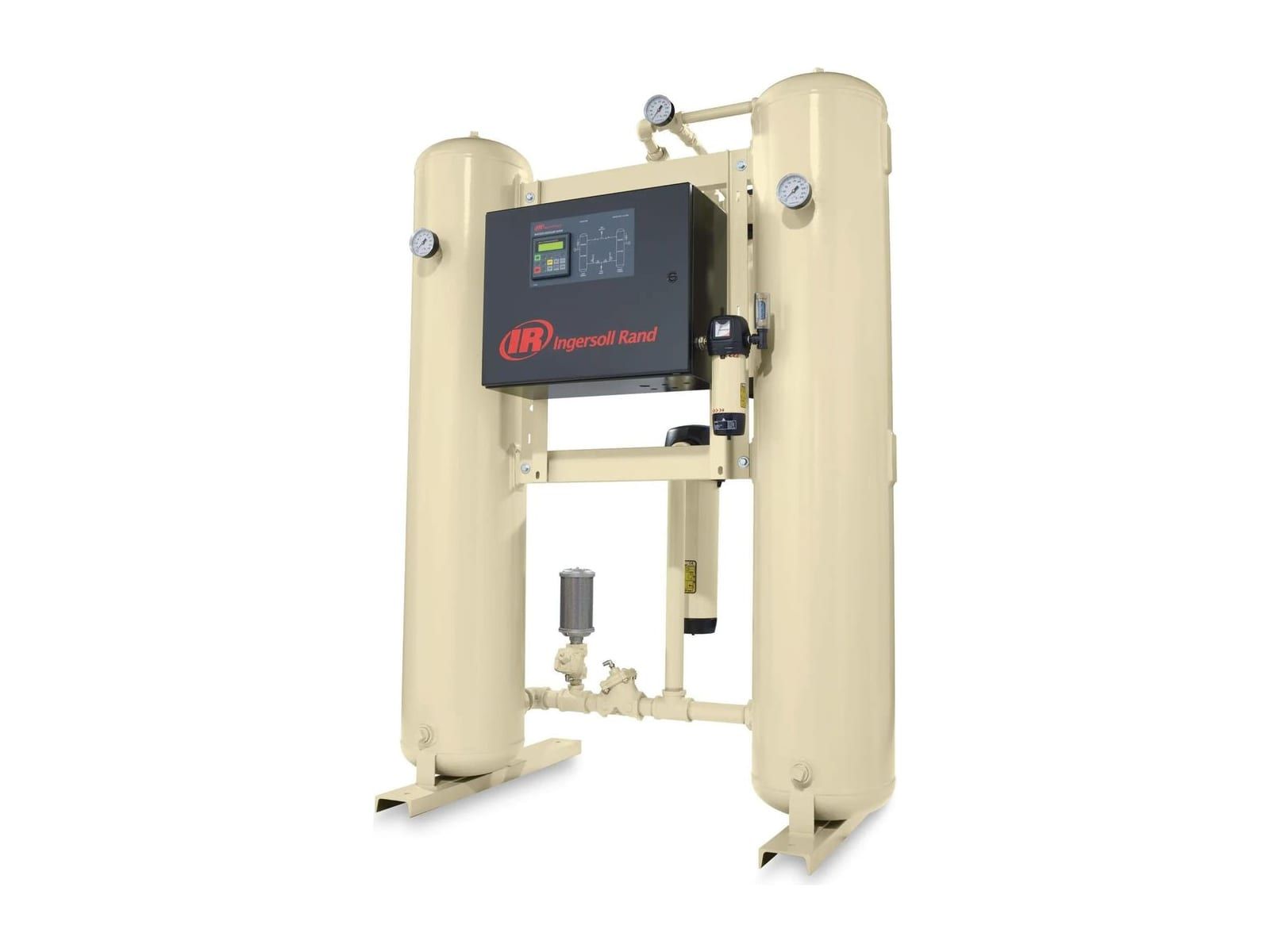
Very dry air, for processes that need it
A refrigerated dryer cannot dry air much below +3 °C pressure dew point, because the water would freeze on its coil. When a process needs drier air, or air lines pass through places colder than that, a desiccant dryer is the answer. It adsorbs water vapour onto a porous material, reaching pressure dew points of -40 °C (Class 2 under ISO 8573-1:2010) or -70 °C (Class 1).
We supply desiccant dryers from the brands we represent. Ask us which series are currently supplied in Cambodia.
How it works
Two towers are filled with desiccant. Compressed air flows up through one tower, which adsorbs the water vapour. Meanwhile the other tower is regenerated: the water it holds is driven off and vented. The towers swap on a timed or dew-point-controlled cycle. Regeneration methods differ in how they use energy:
- Heatless: a share of the dried air is expanded through the regenerating tower. Simple, but the purge air is compressed air the plant has paid for.
- Heated: heaters warm the purge, so less purge air is needed.
- Blower purge: an external blower and heater regenerate with ambient air, using little or no compressed air.
Where it fits
- Pharmaceutical, food and electronics processes with a strict water class.
- Air lines and instruments exposed to cold, including chilled areas.
- Feed air for nitrogen generators.
- Point-of-use dryers serving a few demanding users within a plant dried by a refrigerated dryer.
Selection notes
- Count the purge. Purge air or heater energy is a running cost every hour the dryer operates. Compare regeneration types on your hours and tariff, not purchase price alone.
- Dew-point control. Switching on measured dew point rather than a fixed timer reduces purge at part load.
- Protect the desiccant. A coalescing pre-filter stops oil from coating the desiccant. A particulate after-filter catches desiccant dust.
- Humid inlet. In Cambodia, a hot, saturated inlet loads the desiccant heavily. Sizing must reflect real inlet temperature, often with an aftercooler or refrigerated pre-dryer ahead of it.
What Nexus provides
Class specification, regeneration comparison, installation, dew-point verification at commissioning, and planned maintenance: valve servicing, filter elements, dew-point sensor checks and desiccant replacement.