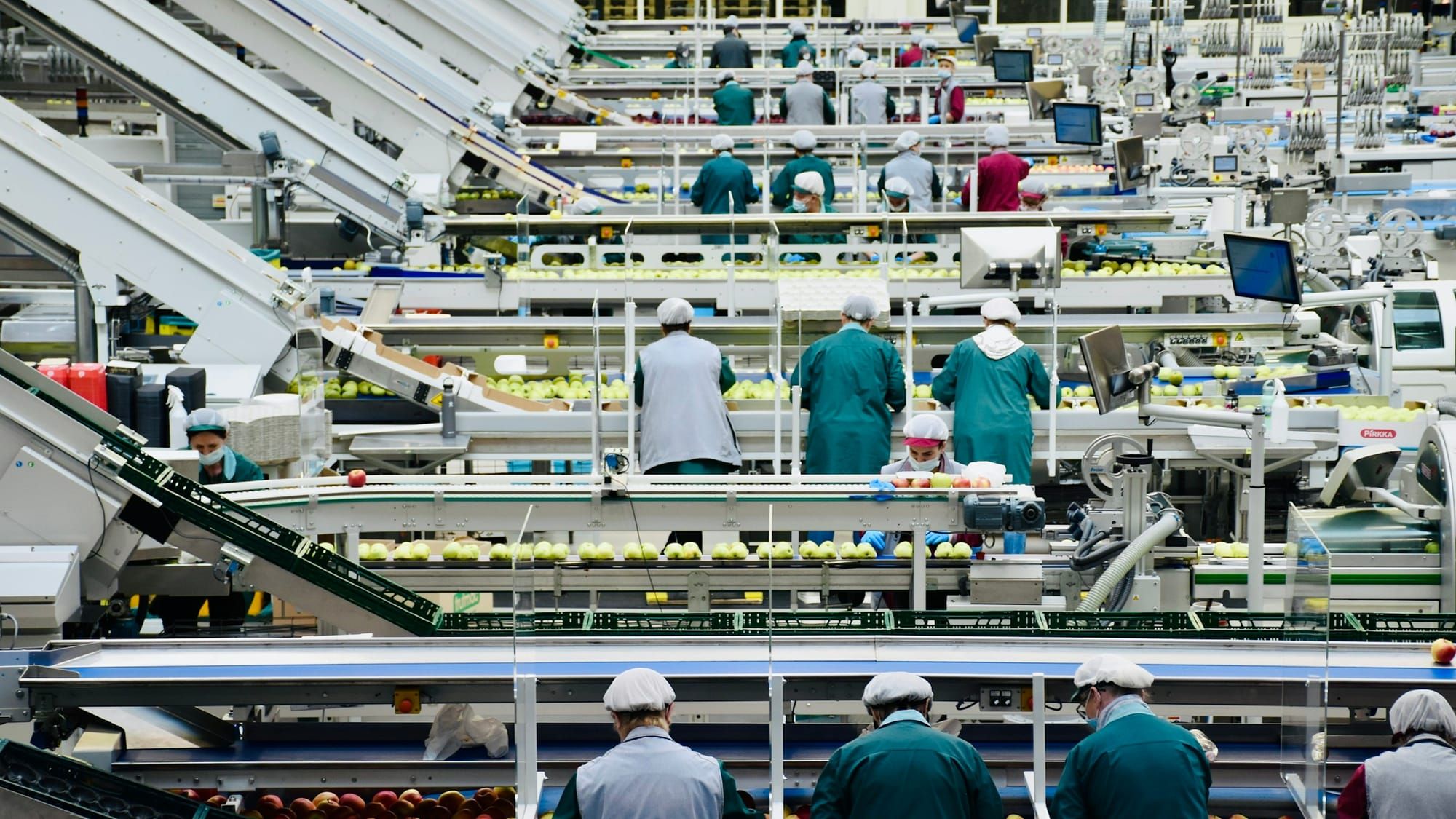
The challenge: air is an ingredient you can’t see
In a food or beverage plant, compressed air is often in direct contact with the product. It blows PET preforms into bottles, cuts and ejects product on conveyors, flushes packs, dries cans and caps, and agitates tanks. Anything in the air ends up on or in the food: oil aerosol, water, particles and, where moisture sits in pipework, micro-organisms.
The risk is easy to underestimate because the air looks clean. A standard compressed-air train can deliver air that is fine for tools and actuated equipment but wrong for product contact. The answer is to treat air like an ingredient: specify it, produce it to that specification, and test it.
Tropical conditions add pressure. Intake air is hot and humid, so compressors and dryers carry more water and more heat. Dry ingredient stores take on moisture through the monsoon. Cold rooms and chilled processes sweat at doors and on uninsulated pipework. Process cooling has to reject heat to an ambient that stays high for much of the year. Washdown adds its own load: hosed floors and steam raise humidity in packing halls, and cold surfaces in chilled areas sweat and drip onto product or packaging.
The air services a food and beverage plant needs
Compressed air to a written purity class
We start by listing every point where air is used and marking it as product contact, indirect contact or utility. Each one gets an ISO 8573-1 class. From there we choose between oil-free and oil-injected generation on lifetime cost and risk. We also decide whether to treat the whole plant to the contact class or treat only the contact points locally. See compressed air systems and our air compressors.
Treatment holds the class. That means a dryer that keeps the pressure dew point well below the coldest pipe it passes, coalescing and activated-carbon filtration where oil vapour matters, and sterile-grade point-of-use filters where the HACCP study calls for them. Condensate from oil-injected machines goes through an oil-water separator. Browse air treatment.
Nitrogen on site
Modified-atmosphere packaging, snack and coffee flushing, edible-oil blanketing and beverage dosing all use nitrogen. A PSA generator produces it at the purity each line needs, from your own compressed air. We size the generator and its feed air together, because feed-air quality decides generator performance. See nitrogen generators and our comparison of nitrogen generators against cylinders.
Humidity control
Powders cake, labels lift, cartons soften and cold surfaces drip. We size dehumidifiers for dry stores, packing halls and areas next to cold rooms, using desiccant-rotor machines where low dew points or low temperatures rule out refrigerant units. Read more on humidity control in pharmaceutical and food production.
Process cooling and low-pressure air
Chillers, cooling towers and air handling units from the HVAC and chillers range carry process and room loads. Low-pressure air for conveying sugar, flour or grain, and for aerating effluent before discharge, comes from blowers selected for the duty.
Monitoring
Dew point, pressure, flow and filter differential pressure go onto one screen with alarms and history through SCADA and monitoring. When an auditor asks how you know the air met spec last March, the historian answers.
What surveys usually find
Surveys of existing food plants tend to turn up the same issues. Dryers are sized for temperate inlet conditions. Point-of-use filters are past their change date, with no differential-pressure indication. Dead legs in the pipework hold moisture. Contact air is drawn from the same header as cleaning guns without local treatment. Each is cheap to fix once it has been found and written down.
Food-grade air is a system and a test plan, not a compressor label.
Standards that apply
ISO 8573-7 gives a test method for viable micro-organisms in compressed air, used where your food safety plan calls for it. ISO 22000 sets out food safety management; compressed air is one of the hazards it expects you to control. We supply the specifications, test results and maintenance records. Certification remains between your plant and its certification body.
Typical scope
| Package | What it usually includes |
|---|---|
| Use-point map | Contact, indirect and utility points, each with an ISO 8573-1 class |
| Generation | Oil-free or oil-injected compressors, sequencing, N+1 standby |
| Treatment | Dryer to target dew point, coalescing, carbon and point-of-use filtration |
| Nitrogen | PSA generator, buffer storage, purity analyser |
| Climate | Dehumidifiers for dry stores and packing, chillers for process loads |
| Verification | Air quality tests at handover, dew-point and pressure monitoring |
The system selector is a quick way to frame the brief. For a full specification, design and engineering produces the P&ID, sizing and test plan, and installation and commissioning proves it on site.