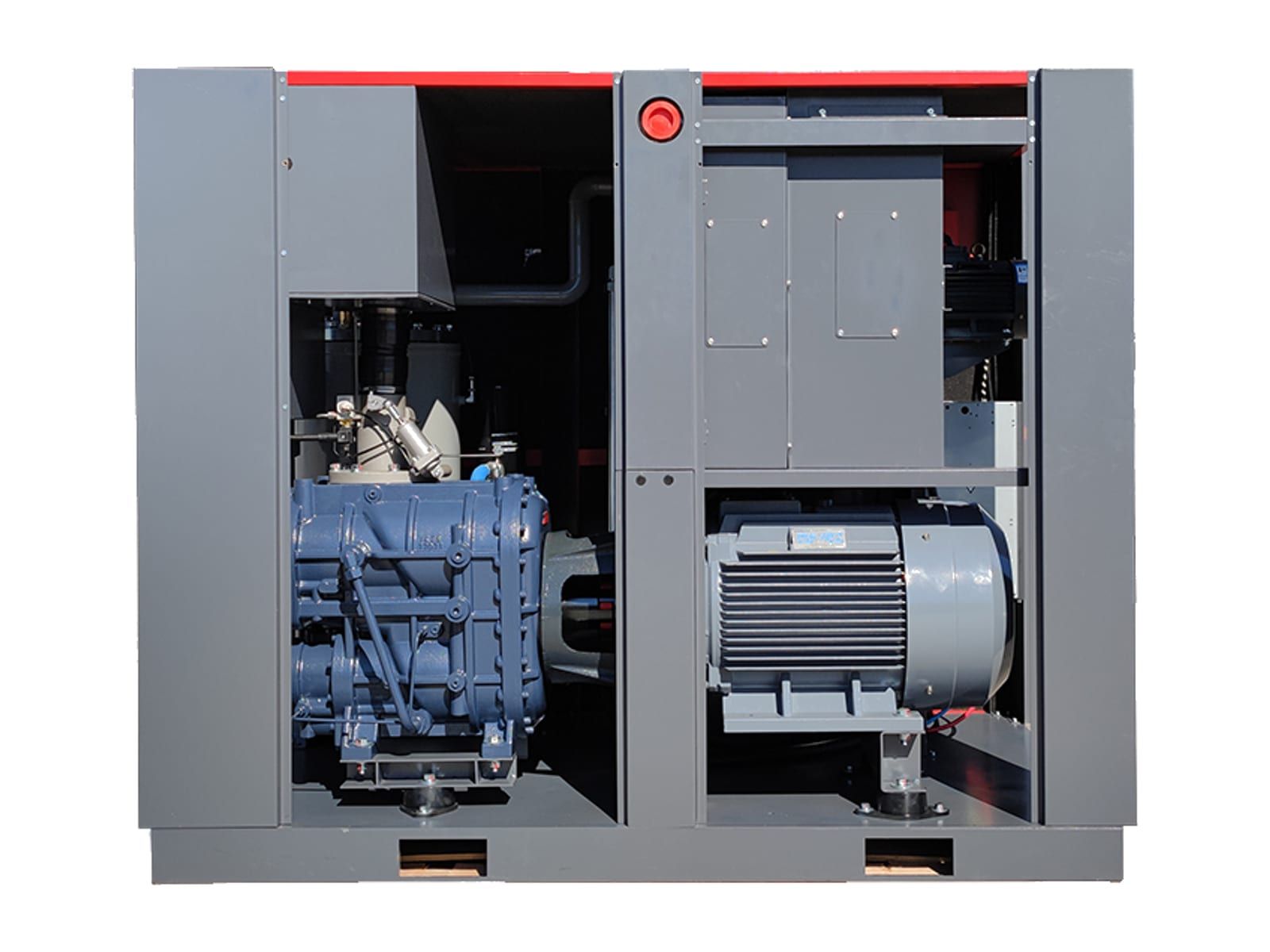
More stages, less work per stage
A single-stage screw compressor raises air from atmospheric to discharge pressure in one airend. A two-stage compressor splits that work between two airends in series. Each stage works across a lower pressure ratio, and the air is cooled between the stages. The physics of compression favours this: compressing in two cooled steps takes less work than compressing in one, and the effect grows with pressure ratio.
We offer two-stage screw packages from the Sollant range we represent. Ask us which series are currently supplied in Cambodia, and we will confirm configurations and datasheets.
How it works
Air enters the first-stage airend and is compressed to an intermediate pressure. Oil injection cools it and carries heat away, then the second-stage airend compresses it to final pressure. Depending on the design, the two stages are driven through a common gearbox or by separate motors. The lower pressure ratio per stage also reduces internal leakage across the rotors. The result, compared on equal terms, is usually better specific power than a comparable single-stage machine, at a higher purchase price.
Where it fits
- Large, continuous duties. Where a compressor runs most hours of the year, the difference in specific power repays the extra purchase cost over its life.
- Base load. A two-stage machine as the base-load compressor, with a variable-speed machine on trim.
- Higher pressures. Where the duty sits at the upper end of the oil-injected screw range.
It makes less sense for small or intermittent duties, where running hours are too low to repay the difference.
Selection notes
- Compare at your duty point. We compare candidate machines on measured specific power at your pressure and flow, using manufacturer data, and calculate lifetime cost on your hours and tariff. You can try the arithmetic with our compressed air cost calculator.
- Plan the room. Larger machines need lifting access, foundation design and ventilation sized for their heat rejection.
- Heat recovery. Large continuous machines are good candidates for heat recovery.
What Nexus provides
Demand analysis, lifetime-cost comparison, room and electrical design, installation and commissioning, and genuine parts and maintenance contracts. Savings are project-specific. We measure them against a baseline and verify them after implementation; we don’t promise a blanket percentage.